
What is a Restorative Ocean Community?
But first, what’s a restorative ocean farm?
I call them “restorative” ocean farms instead of “regenerative” because this isn’t just about the ecosystem: this is about creating multiple systems of care that centre our habitat, our cultural heritage, and our values. Setting up a regenerative farm is one thing—embedding it as a way of life for the entire community makes it restorative for all life.
An ecologically regenerative ocean farm is relatively straightforward: it’s an underwater, polyculture garden of native species that don’t swim away or need any inputs. In cold-water climates, this can include an array of mussels, clams, scallops, oysters, and a variety of seaweeds. In tropical climates, seaweeds abound, but the bivalves differ. For example, in Fiji there’s a restorative ocean farm growing pearl oysters and creating jobs for women in the area; which in turn, allows fathers more time with their children. You can see how the ripple effects grow quickly, and why, when designed carefully, these farms restore entire communities alongside the ecosystem upon which they depend.
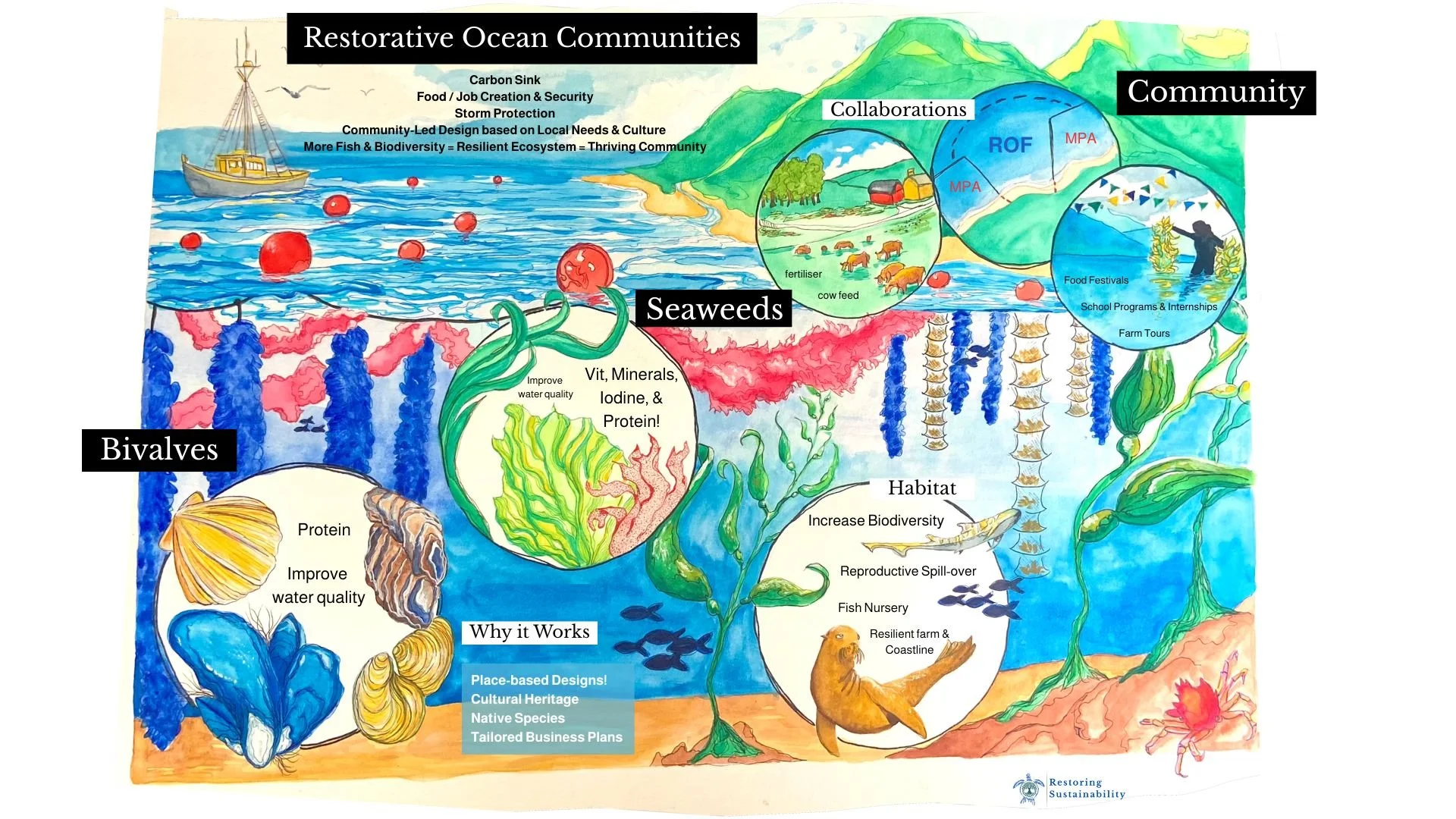
Watercolour illustration of a cold-water Restorative Ocean Farm.
The direct ecological benefits are numerous:
Habitat for juvenile fish and other biodiversity
Bivalves are filter feeders, improve water quality
Kelp absorbs pollution (can clean up contaminated areas and still test at food-grade quality.)
Seaweeds are carbon sinks (absorbing more than trees/other vegetables)
Depending on placement, added storm protection.
Well-sited ROFs can help connect Marine Protected Areas, making them more effective.
Farmers in tropical waters could choose to grow coral for the aquarium trade to reduce local poaching.
And there are cross-ecosystem benefits:
Seaweeds can replace fertiliser on farms, reducing harmful runoff.
Seaweeds can replace soy in countless foods and other products (grasslands, marshes, Savannah, and associated traditional livelihoods have been lost as land is converted to farm it; plus, isn’t everyone allergic to it already?)
No viewshed concerns (just some buoys!)
Easily paired with certain offshore wind farm projects, where fish tend to aggregate anyway, thus supporting more biodiversity.
Then there’s the low-hanging fruit for socio-economic benefits:
Job security for fishers by diversifying income, creating steady income (different species can be harvested at different times of year) and helping fish populations increase via the habitat and some fishing days are replaced with ocean farm days, leading to more fish and bigger fish when they do go out.
Plus job creation on land, including processing and possible harbour improvements.
Food security that will not be impacted by supply chain disruptions (like a pandemic, wars, tariffs, etc.)
Food Sovereignty for Indigenous ocean farmers.
Increased nutritional outcomes: Seaweeds, aka sea vegetables, are HIGHLY nutritious: an excellent source of protein, fiber, and minerals; bivalves are also a healthy source of protein.
But, let’s not forget a critical element: Community.
Any farm, on sea or land, can go from “regenerative” ecologically to “restorative” holistically, if we consider all our relationships. Community-led farms are key to uniting all of the benefits listed above, and identifying new possibilities in line with local culture, needs, and values.
For example, some communities may choose to…
Create business networks between farms (sea & land) and restaurants, strengthening independent, local businesses.
Promote green eco-tourism with farm tours: these tours could be afternoon outings or full-week retreats where people participate in harvests, cooking classes, and learning about local traditional practices.
Farmer’s Markets and/or annual SeaFood Festivals!
Education programs for all ages offering hands-on science experience; data can be shared with the ocean farmers to inform decisions for next season. Education programs can also include art, hospitality, business internships, etc.
Other ways that traditional knowledge and practices can be incorporated and/or revived.
What makes an ocean farm “restorative” is that it heals the relationships between the people and their home, so that all life can thrive. It’s place-based: What grows here? Who lives here? What life supports other life here?
Ecosystems are essentially ‘life-support systems.’ There are countless connections that life depends on to thrive. The more connections there are, the more resilient the ecosystem. That’s how it works with people too: societies are meant to create systems to help us live and thrive. Those systems are how we care for each other. Of course, not all of our systems work well, and the worst are not based on care at all, and so they fail us (and the planet). The fewer connections we have as individuals, the more vulnerable we are.
Restorative Ocean Communities start with the ocean farm, and focus on positive impacts rippling outward. In addition to the examples above, let’s consider an ocean farm in Fiji that grows pearl oysters (J Hunter Pearls). Not only has the water quality dramatically improved, but the farm has provided local women economic opportunities. In turn, fathers have had more time with their children to the benefit of the whole family. You can see how easily impacts can snowball.
If we begin with the intention to see how much we can give, how much we can care for each other, how much we can collaborate—that’s when a Restorative Ocean Farm grows into a resilient, vibrant Restorative Ocean Community. That’s when all life thrives.
If this resonates with you, join my professional development session, Restorative Ocean Community Programming for Nonprofits, which includes the ROC programming tool. Dates vary; see my Luma for the next session.
My free guide for communities wishing to start their own restorative ocean farm is coming soon! Stay tuned.