
The Courage to Walk Away
An Underrated Leadership Skill
Sometimes realising a project or job isn’t the right path, and acting accordingly, can take a huge amount of courage.
Over Summer, I had the pleasure of doing a site visit to evaluate a potential regenerative space. It was beautiful, and sustainable timber harvesting was already well established. The vision was there, the business plan was simple but thorough, and considerations were taken to ensure local culture would thrive alongside native biodiversity. A list of potential partners and community relationships was at the ready.
But, there was one undecided detail. At first glance, a minor hitch, something that could have a workaround, perhaps, and this family of aspiring entrepreneurs and wilderness lovers were indeed looking for a workaround.
If I only cared about making money, I would have urged them to push the project through despite seeing the potential for conflict. Of course, conflict isn’t unusual, and it doesn’t mean a project is doomed to failure. Conflict resolution is a leadership skill. But so is asking, “Is this project right for this place? For this group? For this time?”
In this time of urgency, and in a culture that praises the courage to act boldly and quickly, taking a breath can be hard. Yet, this simple moment of reflection can save leaders, teams, and organisations so much money. We often think this question is inherently answered by creating the project in the first place—in sustainability, restoration, conservation, and other environmental and social work, our projects are meant to serve. They are addressing an issue, and often intended to be what this group, in this place, needs right now.
Yet, in our zeal to help, in all our planning and designing, we can miss details. That’s a huge reason why I created the Questions of Care Methodology Guide. Originally meant to address serious holes in our legal procedures and interpretation, like Environmental Impact Assessments, these questions lend themselves to preparation for projects at any scale. And Question 5 asks, “Is this project right for this place?” It follows questions that require us to understand both the natural and social history of the place, and with that information, we can pause to reassess the project. Maybe it needs a small tweak to make a big impact—or maybe it’s actually not right at all.
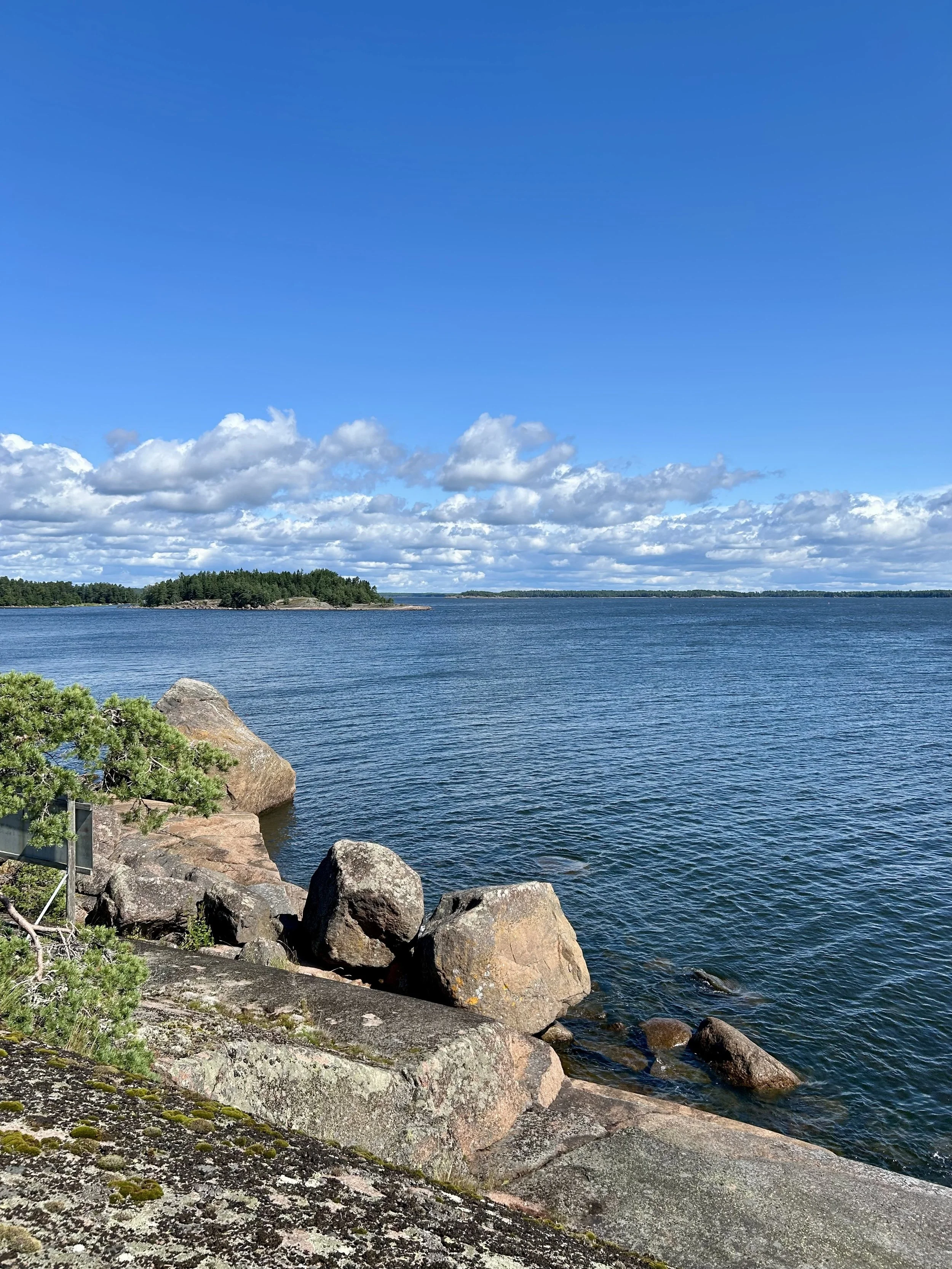
The calm waters of the Baltic Sea, Finland, Summer 2026.
In this case, the social history of the place is the family’s history. And this undecided detail, though small, could put current relationships at risk. Naturally, this could put the entire project at risk.
It is not my job to tell people what to do—as a sustainability strategist and leadership coach, it is my job to help build capacity for decision-making so that people can make the best decision for themselves and their organisation. I did some research and found that the law provided a simple resolution that would clear the path for the project to move forward. We discussed various scenarios. I asked questions. A couple of hard questions, but necessary ones. For example, do we want to resort to the law to resolve this issue? How will it impact the family relationships?
The family came to the conclusion that while the project design was well-done and the place was ripe for such growth, now was not the right time. This one detail had to be resolved first for the project to be a success, and it needed to be resolved together, as a family, not a legal matter. Disappointed but not discouraged, they agreed to continue to preparing for the project and seek out a different site. Resilience is the ability to bounce back from delays, and they are a resilient bunch.
I was reminded again that two things can be true: we do need bold, swift action in response to the poly-crisis; but we also need to do it as a family, as a team, and as a community. Sometimes that means taking the time to come to consensus or moving a project elsewhere—but it always means listening and coming from a place of care.
Some food for thought, for your leadership practice:
When have you pushed forward with something that looked good on paper but didn’t work out in practice? How does that inform your decision-making now?
When have you left things that weren’t right for you? When have you had to stir your team or organisation away from a project or goal that appeared great at first glance, but somehow you knew better?
How much courage did it take? How did you feel after?
If you’d like to continue exploring how to lead courageously with a supportive group of peers, join our online workshop on the 8th or 10th of September. It’s part of the free Autumn series Rooted Leadership, for women leading our sustainable future.