And Your Invitation to Experience the Power of Community Care
Climate grief, or ecological grief, is finally gaining more mainstream attention. For example, many jurisdictions across Australia have passed legislation requiring employers to mitigate the negative impacts of ecological grief just as they are required to mitigate other workplace health and safety issues. For many of us, it will be somewhat of a relief to have words for what we feel. Philosopher Glenn Albrecht gave us terms like solastalgia, a homesickness that’s impossible to ease because your landscape has forever been changed by environmental destruction, and terrafurie, the rage we feel over mindless environmental destruction. His work began by observing the grief of Indigenous People over the loss and environmental harms to their homelands, and he extended the idea to all people. We all grieve when Nature is lost, especially the Nature of our home.
We experience ecological grief on a global scale as climate change threatens to destroy life as we know it. The news tells us about floods, extinctions, fires, and tragedies across the world, while we watch the landscape closest to us undergo harm from extreme heat, drought, shorter Winters, bark beetles, subdivisions, pollution, and an assortment of other incremental damages that add up to a place we no longer recognise.
The five stages of grief have helped us understand how we process loss—however, they’re based on acute loss, like the loss of a loved one. But how do you process chronic loss? Something you are forced to witness day after day? Never mind the losses that we know are coming, and the anger that rises from the lack of easy prevention. Wounds don’t heal if they’re repeatedly ripped open. We need a different approach.

Currently, many Finnish locals are experiencing “Winter Grief” due to the warming climate altering their traditional Winter Season.
Climate Grief Competency seeks to address exactly this issue. While the name is direct, although maybe a bit sterile, I was pleased to find that compassion and community support are central to this approach.
Dr Janet Lewis was quoted by Charlie Hertzog Young, saying that,
The goal is not to get rid of climate despair. The goal is to transform it into what is bearable and useful and motivating.
Young explains that this process is “…one that takes time but can lead to newfound connection, purpose, meaning, belonging, and mutual support.”
Our mental health often boils down to how well we cope with the stresses of life—but not all coping is healthy, and unhealthy coping can lead to some very maladaptive behaviours in the long run with serious consequences.
Common, unhealthy coping mechanisms are often rooted in some form of denial or avoidance. People will say (or think) things like…
Everything will be fine; technological innovation will save us.
We have to stay positive, or people will give up.
Don’t get emotional, just do the work.
Unprocessed eco-grief appears in our daily lives in a variety of ways:
Anxious thoughts
The inability to relax, leaving only disengagement and numbness
Exhaustion to the point of avoiding social interactions
When unhealthy coping mechanisms continue, ecological grief transforms into anxiety. The American Psychological Association has found that maladaptive eco-anxiety can lead to:
Panic attacks
Irritability
Loss of appetite
Physical weakness
Insomnia
In some cases, people may start to feel overly responsible for environmental and social harms. For example, a handful of classmates admitted to me that they left grocery stores empty-handed, choosing to skip dinner that day because they couldn’t see the supply chain of the food and therefore couldn’t make an informed choice; they preferred the discomfort of hunger to the emotional pain of being part of a harmful system. One person had a mild panic attack in the grocery store and told her spouse that he had to do the grocery shopping for the next few months because she couldn’t bear to think about it.
Climate Grief Competence
is the practice of a variety of healthy coping activities so that we can process our grief and transform it as Dr Lewis describes. Those who cultivate climate grief competence regularly (though not perfectly) are able to…
Acknowledge losses
Process loss as an individual and as part of a community
Engage in collective action
Processing loss is often where people get hung up. My searches so far have turned up a lot of discussions about what ecological grief and eco-anxiety are and how they negatively impact our mental health, but only a few have discussed how to handle it. That could be due in part to a simple fact that creates a lot of nuance: There is no “best” or “right” way to grieve, and what is helpful for one person could be useless to another—which doesn’t make for an easy study or eye-catching self-care/how to post.
Despite this, we have considerable evidence that one of the most significant predictors of adaptation to loss is social support, including emotional, informational, and practical support. The power of peer groups is increasingly acknowledged in mainstream psychology. People with shared experiences are able to connect and provide empathy, understanding, and perspective. Further, when it comes to systemic issues, it takes collective effort to address the cause of mental dis-ease.
In my readings, I have found these key factors for coping (and thriving) appear on repeat:
We need a supportive community
We need to engage in collective action, AND
be satisfied with what we contribute.
And that’s where I’m going to start: creating a supportive community. I sincerely hope that you can join my first free event. It’s designed to introduce everyone to the topic, share coping tools, engage in one grief processing exercise, and, hopefully, everyone will leave the meeting feeling better than when they arrived. Because co-design is a critical element of these initiatives, this gathering is an offering to test the waters and will be followed by a survey should you choose to join (and co-design!) with us in the future.
Wishing you all the best this holiday season. Feel free to share this post with a friend or colleague.
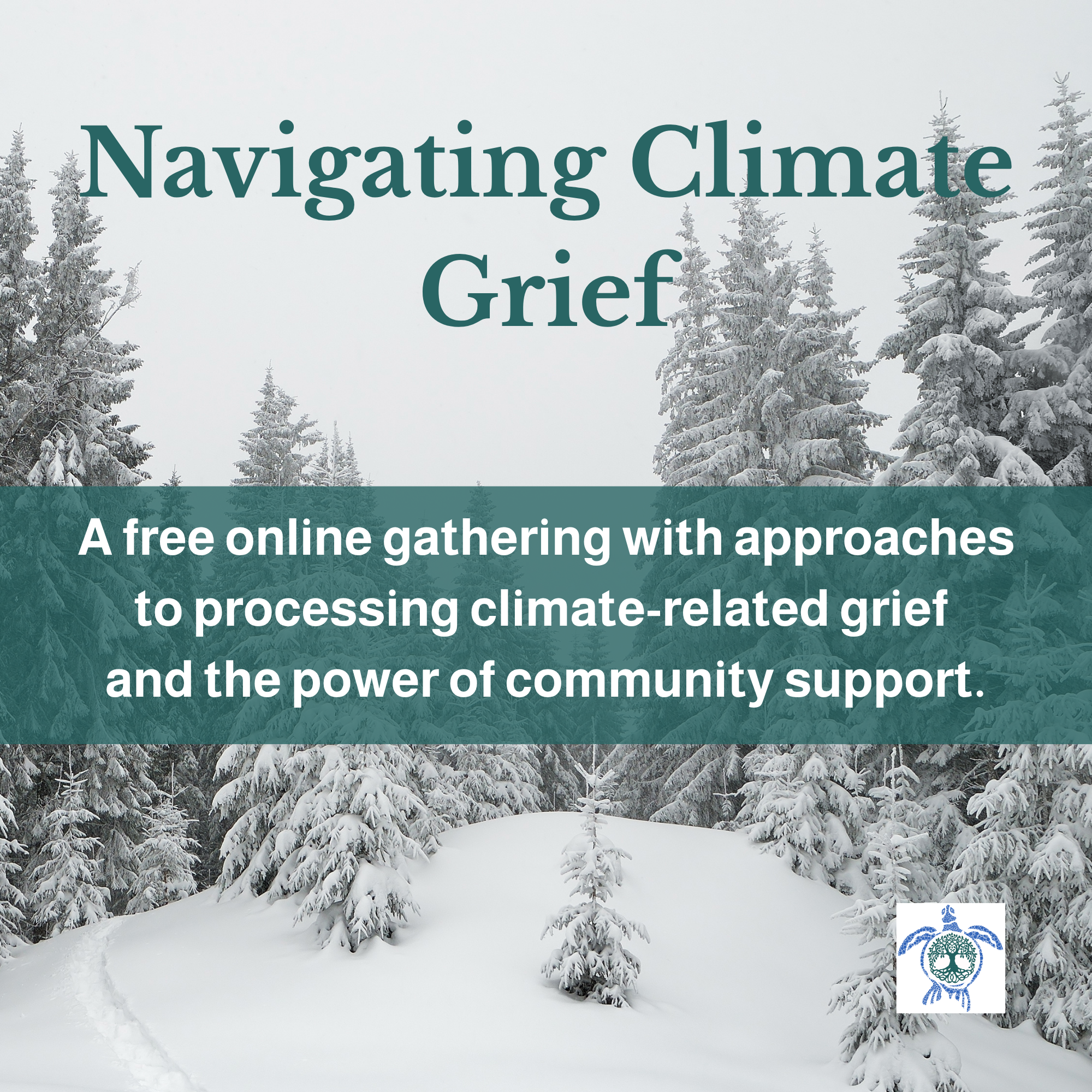
Navigating Climate Grief, a free community gathering / 9am Pacific, 12pm Eastern, Saturday 7 November / Register here.